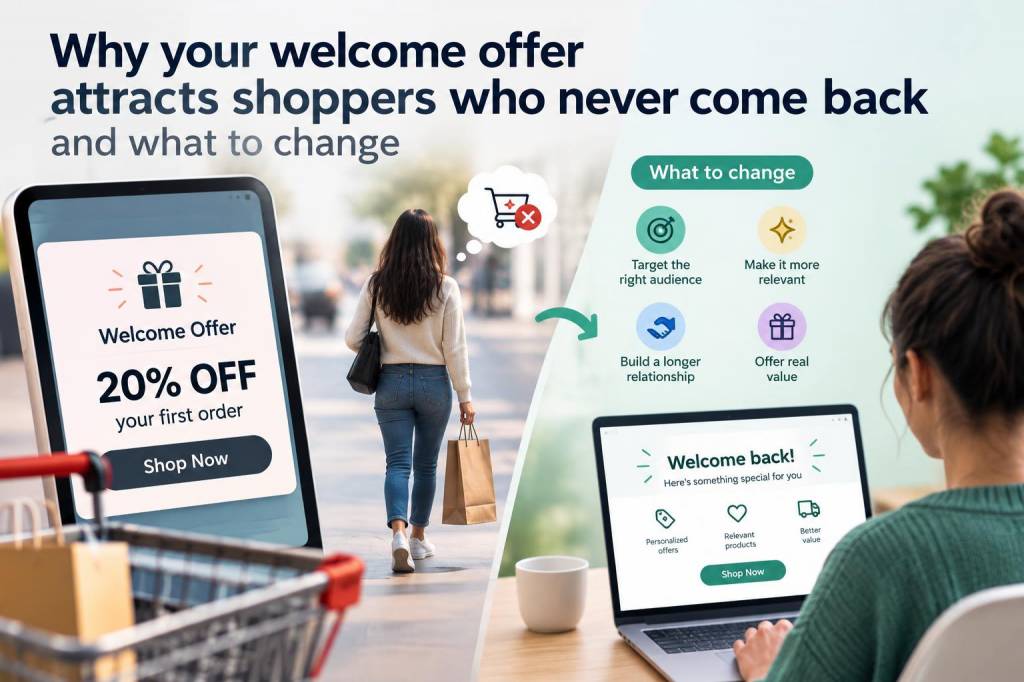
I have seen a pattern repeat across retail, e-commerce, and service businesses: a welcome offer brings in a wave of first-time buyers, the campaign looks strong on paper, and then repeat purchase rates stay flat. On the surface, it feels like success. In practice, it often means the offer attracted people who were already deal-seeking, not people with any real reason to stay.
That is not because welcome offers are useless. I use them myself when they are part of a wider retention plan. The problem appears when a welcome offer does all the work. If a discount is too large, too broad, or too disconnected from a brand’s real value, it can train shoppers to treat your business as a one-time transaction. They arrive for the saving, buy once, and leave as soon as a cheaper option appears elsewhere.
Why welcome offers can create one-time buyers
A welcome offer is supposed to lower friction. It should help a new shopper take a first step, not become the only reason they came in at all. When I review underperforming loyalty and retention programs, I usually find one of five issues.
First, the offer overshadows the product. If your subject line, landing page, and checkout message all scream about price, shoppers remember the discount more than they remember what they bought. They learn to wait for another incentive rather than build a habit with your brand.
Second, the offer attracts discount-first shoppers. Some customers are perfectly legitimate, but they are highly responsive to promotions and very low in brand attachment. If your acquisition channel is filled with people searching for vouchers, promo codes, and one-off savings, your offer may be filtering for the wrong audience.
Third, the experience after purchase is weak. A welcome offer often gets blamed when the real issue is post-purchase friction. Slow delivery, confusing onboarding, weak product education, poor email follow-up, or a forgettable second-buyer journey can stop repeat behavior even when the first purchase was profitable.
Fourth, there is no bridge to a second purchase. Many businesses stop once the welcome order lands. They do not design a next step, a replenishment prompt, a cross-sell path, or a reason to come back. Without that bridge, the offer becomes a dead end.
Fifth, the economics are upside down. If the discount is too generous, it may attract customers whose lifetime value never justifies the acquisition cost. A strong conversion rate can hide a poor unit economics problem for months.
What I look at before changing a welcome offer
When I audit a welcome offer, I do not start by asking whether it converted. I start by asking whether it converted into the right kind of customer. That difference matters.
I normally check these signals:
- Repeat purchase rate within 30, 60, and 90 days
- Average order value for first-time buyers versus returning buyers
- Redemption rate by acquisition channel
- Customer lifetime value by campaign source
- Margin impact after discount, shipping, and returns
- Email engagement after first purchase
- Second-order conversion from welcome flows
If one channel produces a flood of first orders but almost no second orders, I treat that as a warning sign. If one offer lifts volume but lowers average basket value or repurchase intent, I treat that as a design problem, not a marketing win.
What usually needs to change
The answer is rarely “remove the welcome offer.” In most cases, I change what is offered, when it is offered, and who receives it.
Make the offer smaller, but more relevant. A large discount can produce shallow loyalty. A smaller offer tied to a meaningful first step can do more for retention. For example, a modest money-off incentive paired with a product recommendation, free delivery threshold, or bonus reward point can feel more branded and less transactional.
Use value beyond price. Some of the strongest welcome incentives are not discounts at all. Early access, bonus points, a free add-on, a sample, a content pack, or a members-only benefit can create a more durable relationship. Price reductions are easy to understand, but they are not always the strongest retention lever.
Match the offer to product lifecycle. A consumable brand can use replenishment timing to encourage a second order. A fashion brand may need a style-based incentive or a curated follow-up. A B2B or service brand may benefit more from a consultation, audit, or onboarding perk than from a one-time price cut.
Delay the reward until after a high-value action. Instead of giving the entire benefit at signup, I often test a structure where the customer earns more value after their second order, profile completion, subscription setup, or product review. This shifts attention from the first transaction to the relationship.
Segment by intent. New subscribers are not all equal. Some need reassurance, some need education, and some are ready to buy immediately. I prefer offers that vary by entry point, channel, or behaviour. Someone arriving from organic content may need a different welcome path from someone arriving through a paid voucher search.
How I rebuild the welcome journey
My favourite fix is usually a sequence rather than a single offer. A welcome message should start a relationship, not finish one.
I like to think in terms of four stages:
- Arrival: clear value proposition and simple sign-up reason
- First action: a low-friction purchase or engagement step
- Reinforcement: product education, social proof, and usage support
- Return trigger: a reason to buy again, earn more, or unlock something better
For example, a skincare brand might offer a smaller welcome incentive, then follow with a routine-building email, a usage reminder, and a second-order reward linked to replenishment timing. A food retailer might combine a modest discount with recipe content, basket-building suggestions, and a reactivation nudge before household stock runs out. A business software brand might replace discounting with a free setup session and a follow-up milestone that encourages deeper adoption.
The point is to make the first purchase feel like the beginning of something useful. If the first order stands alone, there is no emotional or practical reason to return.
Messages that create the wrong expectation
One issue I see constantly is tone. A welcome offer can accidentally set the wrong relationship from day one.
If your messaging says, “Here is a discount because we need to win you over,” you may be implying that your core value is weak. If it says, “Buy now before the deal disappears,” you may attract urgency-driven buyers who never develop trust. If it makes price the central story, customers may assume price is all you have to offer.
I prefer language that frames the offer as an introduction to a larger experience. That means emphasizing quality, usefulness, convenience, service, or belonging. Even a discount can be positioned as a first step into a better ongoing experience.
Here is a simple comparison of common approaches and their retention effect:
| Offer style | Likely short-term effect | Likely retention effect |
|---|---|---|
| Large percentage discount | Fast sign-up and strong first order volume | Can attract low-loyalty buyers and price shoppers |
| Small discount plus second-order reward | Moderate first order volume | Better incentive for return behaviour |
| Bonus points or membership benefit | Good if value is easy to understand | Often stronger for long-term engagement |
| Free sample or add-on | Encourages trial and product discovery | Can support habit formation and cross-sell |
Signals that your current offer is pulling in the wrong crowd
I usually know a welcome offer needs work when I see these patterns:
- High first-purchase conversion, but weak repeat rate
- Heavy use of coupon sites or deal-driven traffic sources
- Low email engagement after redemption
- Customers buying only during promotions
- Low average order value compared with non-discounted customers
- Very few customers joining a loyalty program after the first order
- Support tickets or returns clustering around first-time buyers
These signs do not always mean the offer is broken. Sometimes they reveal a product-market fit issue, channel mismatch, or post-purchase experience gap. But they always tell me to look deeper than simple conversion data.
What to test next
If I were changing a welcome offer for an SME, I would not launch five dramatic experiments at once. I would start with controlled, practical tests.
One test might compare a high discount against a lower discount with a second-order incentive. Another might compare a price-based offer with a value-based offer, such as bonus points or free delivery. A third might compare immediate redemption with delayed redemption after a second purchase or profile action.
I also like testing message framing. A promotion-led headline often behaves differently from an experience-led headline. Even small wording changes can alter who signs up and why they stay.
And I would not stop at acquisition metrics. I would watch what happens over time: do welcome buyers become regular customers, or do they disappear after the first order? Do they spend more, return faster, and engage more deeply when the incentive is restructured?
That is where a welcome offer becomes a real retention tool instead of a temporary sales spike.