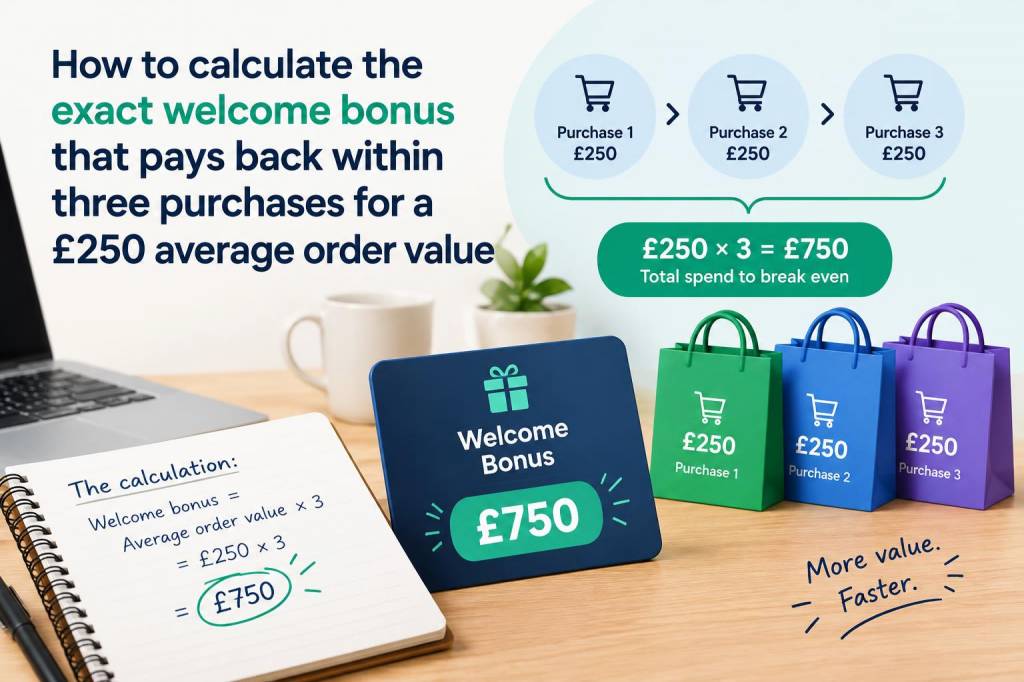
I often get asked a deceptively simple question: how generous should our welcome bonus be? For SMEs the right answer balances two things — it must be compelling enough to drive behaviour (first repeat purchases), and it must be profitable. In this post I’ll walk you through a straightforward, repeatable way to calculate the exact welcome bonus that pays back within three purchases for a £250 average order value (AOV).
Why “pays back within three purchases” is a sensible target
Three purchases is a pragmatic horizon for many small and mid-sized brands. It’s long enough to capture an early retention signal (customers who come back 2–3 times are more likely to be long-term), and short enough to keep the financial exposure of the welcome incentive limited. In practice, targeting payback within three purchases forces you to be economical: the welcome offer must drive incremental value quickly.
Key metrics and assumptions you need
Before we crunch numbers, collect or estimate the following for your business. If you don’t have perfect data, use conservative estimates and test.
We’ll use concrete example values in the next section so you can follow the math.
Step-by-step calculation (worked example)
Assumptions (example):
Goal: Find the maximum per-customer welcome bonus (face value) that allows the incremental contribution from additional purchases to cover the cost of the bonus within 3 purchases.
1) Calculate incremental number of customers making repeat purchases
Incremental repeat rate = uplift = 15 percentage points. For 1,000 new customers:
| New customers | 1,000 |
| Incremental repeat customers | 1,000 × 15% = 150 |
These 150 extra customers are the ones we attribute to the welcome bonus (they wouldn’t have bought again without it).
2) Calculate incremental contribution from extra purchases
Assume the welcome bonus drives exactly one extra full-price purchase within the 3-purchase window (we can refine later if you expect multiple repeats).
Incremental contribution per extra order = contribution margin = £100
Total incremental contribution = 150 × £100 = £15,000
3) Compute total cost of the bonus
Total redemptions = total recipients × redemption rate = 1,000 × 60% = 600 redemptions
But some portion are cannibalised: non-incremental redemptions = 600 × 30% = 180 (these cost you money but don’t create incremental revenue)
Incremental redemptions = 600 − 180 = 420 (these correlate to incremental purchases — note this can differ from the 150 incremental repeat customers if your setup allows multiple non-incremental redemptions; alignment matters)
For our simple model we allocate costs across all redemptions. Let x be the face value of the welcome bonus (the discount amount or voucher value). Total face-value cost = 600 × x
Plus admin costs = 600 × £2 = £1,200
4) Equate incremental contribution to total cost to find break-even x
We want the incremental contribution (£15,000) to cover the total cost:
15,000 = 600x + 1,200
600x = 13,800 → x = £23
Interpretation: with these assumptions the maximum welcome bonus face value that pays back within the three-purchase window is about £23 per customer.
Refinements and sanity checks
That figure feels reasonable for a £250 AOV — it’s roughly 9% of AOV. But there are important nuances:
Alternative model: bonus tied to next-purchase spend (e.g. £X off £Y)
I often prefer structure-based bonuses: for example, “£20 off when you spend £75” rather than an unconditional voucher. This reduces cannibalisation and increases perceived value.
To model that, estimate the average order when the voucher is redeemed and the incremental margin on the basket above the threshold. Often these promotions improve AOV (customers add items to reach threshold), which increases your effective margin per redemption.
Practical recommendations for SMEs
Quick checklist before you launch
Welcome bonuses are a powerful tool when designed with discipline. By working through the numbers — and validating with experiments — you can pick a welcome offer that both excites customers and protects your margins. If you want, I can help run the calculations on your actual data or set up an A/B test plan tailored to your stack (Shopify, WooCommerce, custom platform) and customer base.