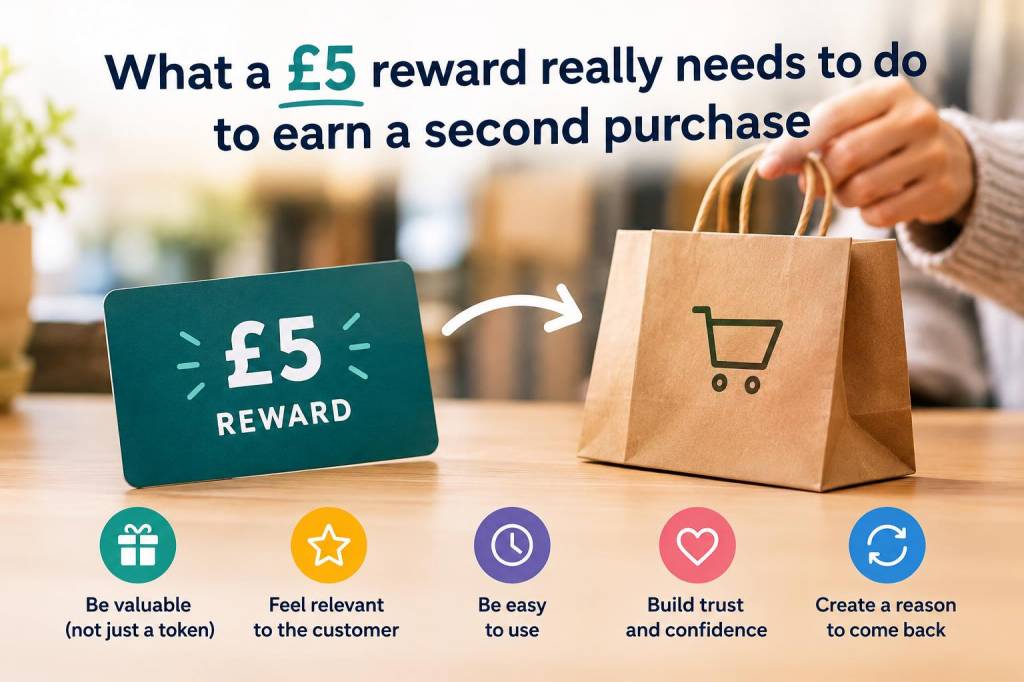
A £5 reward sounds modest on paper. In a customer’s mind, though, it is never just £5. It is a signal. It says, “we noticed you,” “we want you back,” and, if I have designed it well, “coming back will feel easy.”
When I look at rewards that actually drive a second purchase, I rarely see value doing all the work on its own. A £5 reward is not powerful because it is large. It works when it clears a very specific set of hurdles: it feels relevant, it is easy to use, it arrives at the right moment, and it reduces just enough friction to make another order feel sensible rather than forced.
I have seen businesses spend far more than £5 to create a reward that does nothing, and I have seen a carefully timed £5 voucher outperform a much richer offer. That difference usually comes down to behavioural design, not budget. If you want a small reward to earn a second purchase, it must do more than discount a basket. It must change a decision.
What a second purchase really asks from a customer
A first purchase is often driven by curiosity, need, or a one-off trigger. A second purchase is different. It asks for trust. It asks for memory. It asks for a reason to return when there are many easier ways to spend money elsewhere.
That is why a £5 reward has to work on several levels at once. It should remind the customer that your brand exists, make the next order feel slightly more worthwhile, and reduce hesitation at checkout. If any of those elements is missing, the reward becomes background noise.
I think of the second purchase as a small but important emotional test. The customer is asking:
- Was my first experience good enough to repeat?
- Is there a clear reason to come back now?
- Will using this reward feel simple, fair, and worthwhile?
- Do I still care enough to take action?
A £5 reward has to answer those questions fast.
Value is not enough unless it feels meaningful
In isolation, £5 is not a life-changing amount for most customers. That is exactly why presentation matters. A reward that feels small on your spreadsheet can feel much bigger when it is positioned as earned value rather than random discounting.
I have found that customers respond better when a £5 reward is framed as something they unlock rather than something they are simply handed. The psychology shifts. It feels like progress, not charity. It feels like a benefit tied to behaviour, which makes it easier to justify returning.
This matters even more when your product sits in a crowded market. If competitors are shouting about percentage discounts, free shipping, and bundles, your £5 reward needs a sharper role. It may be less about pure savings and more about nudging timing, increasing basket size, or encouraging a next step before a competitor wins attention.
What a £5 reward needs to do in practice
From my experience, a small reward earns a second purchase only when it does at least one of five jobs well.
| Job | What it means | Why it matters |
|---|---|---|
| Reduce friction | It makes checkout feel slightly easier | Small barriers often stop repeat buying more than price does |
| Create urgency | It has a clear expiry or usage window | Without a reason to act soon, many customers delay and forget |
| Increase relevance | It fits a product, category, or purchase cycle | Generic rewards feel weak; relevant rewards feel useful |
| Encourage a bigger basket | It can be used after a minimum spend | This protects margin and increases order value |
| Reinforce habit | It supports a repeat routine | Returning becomes part of the customer’s pattern |
A £5 reward that does none of these things is just a cost. A £5 reward that does two or three of them becomes a lever.
Timing often matters more than amount
If I had to choose between a larger reward at the wrong time and a smaller reward at the right time, I would usually choose the smaller one. Timing is often where repeat purchase momentum lives.
For example, a customer who buys skincare may be most receptive when they are near depletion. A customer who buys coffee beans may respond when their last bag is likely running low. A customer who buys stationery, accessories, or consumables may be more likely to return shortly after the first order if the use case is obvious and the reminder arrives before attention fades.
That is why I like to map reward delivery to customer behaviour rather than calendar dates alone. A £5 reward sent too early can feel irrelevant. Sent too late, it arrives after the customer has already replaced you with another option.
The most effective timing usually comes from one of these moments:
- Shortly after positive delivery or usage experience
- Near the likely repurchase window
- After first engagement with your email or app
- After a browse event that signals renewed interest
- When a customer has not returned, but still shows brand affinity
That last one matters a lot. A dormant customer is not always lost. Sometimes they simply need a timely reason to return before the memory fades completely.
Clarity can beat generosity
One of the most common mistakes I see is overcomplicating a reward that should feel obvious. Customers do not want to decode a small reward. They want to know exactly what it does and when it works.
If a £5 reward is buried behind unclear rules, hidden minimums, or awkward exclusions, it loses power fast. The customer starts doing mental maths. At that point, the emotional energy that could have driven repeat purchase is being spent on interpretation.
I prefer rewards that are easy to explain in one sentence. For example:
- “Use £5 off your next order over £25.”
- “Enjoy £5 off your next purchase within 14 days.”
- “Get £5 toward your next item in this category.”
Each version gives the customer a reason to act and removes uncertainty. That is especially important for SMEs, where every extra click or question can lower conversion.
Why small rewards sometimes outperform bigger ones
It may seem strange, but I have seen small rewards outperform larger offers because they feel more believable. A very generous reward can raise suspicion. Customers may wonder whether prices are inflated, whether the offer is temporary, or whether there is a catch.
A £5 reward is often believable enough to trust and meaningful enough to notice. That is a useful combination. It can also feel more aligned with brand quality than deep discounting. In many categories, heavy discounting trains customers to wait, while a modest reward trains them to return.
There is also a margin effect that matters for repeat purchase strategy. A small reward can be sustained more easily across many customers, which means it can support broader loyalty behaviour rather than a one-off burst of bargain hunting.
Message matters as much as mechanics
Customers rarely remember the exact structure of a reward program, but they do remember how the reward made them feel. That is why the message around a £5 reward should be direct, warm, and specific.
I try to make the message feel like a continuation of the first purchase experience rather than a separate sales push. The tone should say, “We want you back because you matter,” not “Please buy again because we need revenue.” Customers sense that difference immediately.
Here are a few message ingredients that help:
- Simple language
- Clear value
- Visible expiry or next step
- One action only
- Connection to the previous order
When a reward is communicated well, it feels like a private invitation. That feeling can be more persuasive than the actual money value.
What I measure before I call it effective
I never judge a £5 reward only by redemption rate. Redemption matters, but it is not enough. A reward can be redeemed by people who would have bought anyway. That does not tell me whether it truly changed behaviour.
To understand whether a small reward is working, I look at:
| Metric | What I want to learn |
|---|---|
| Second purchase rate | Did more customers come back? |
| Time to second order | Did the reward speed up return behaviour? |
| Average order value | Did the reward lift basket size? |
| Redemption share | How many customers used the reward? |
| Incremental margin | Did the programme create profitable repeat revenue? |
I also compare against a control group when I can. Without that, it is too easy to mistake normal repeat behaviour for reward impact.
When £5 is not enough
There are times when a £5 reward will not do the job. If your category is highly commoditised, if your purchase cycle is long, or if customers need a stronger emotional reason to return, a small reward may not be enough on its own.
In those cases, I do not automatically increase the discount. I first ask whether the reward needs better structure. Could it be paired with early access? Could it unlock a useful perk? Could it sit inside a tiered journey that makes the second purchase feel like progress?
Sometimes the answer is yes. Sometimes the answer is that the reward needs a different role entirely, such as protecting a margin-heavy product while a separate offer drives first-time reactivation.
What I try to avoid is throwing more money at a weak design. A poorly timed £10 reward is still a poor reward.
The real test is whether it changes behaviour
In the end, a £5 reward earns a second purchase only if it changes the customer’s next decision. That means it must be noticed, understood, trusted, and easy to use. It should make returning feel like a sensible next step, not a chore.
When I build or review a reward, I ask a simple question: if I removed this £5 offer, would the customer still feel a reason to come back now? If the answer is yes, the reward may be too weak or too generic. If the answer is no, then I know I am closer to something useful.
The most effective £5 reward does not try to impress. It tries to remove doubt. It reminds the customer of value already experienced, gives a clear next action, and turns a near-future possibility into a near-term purchase.