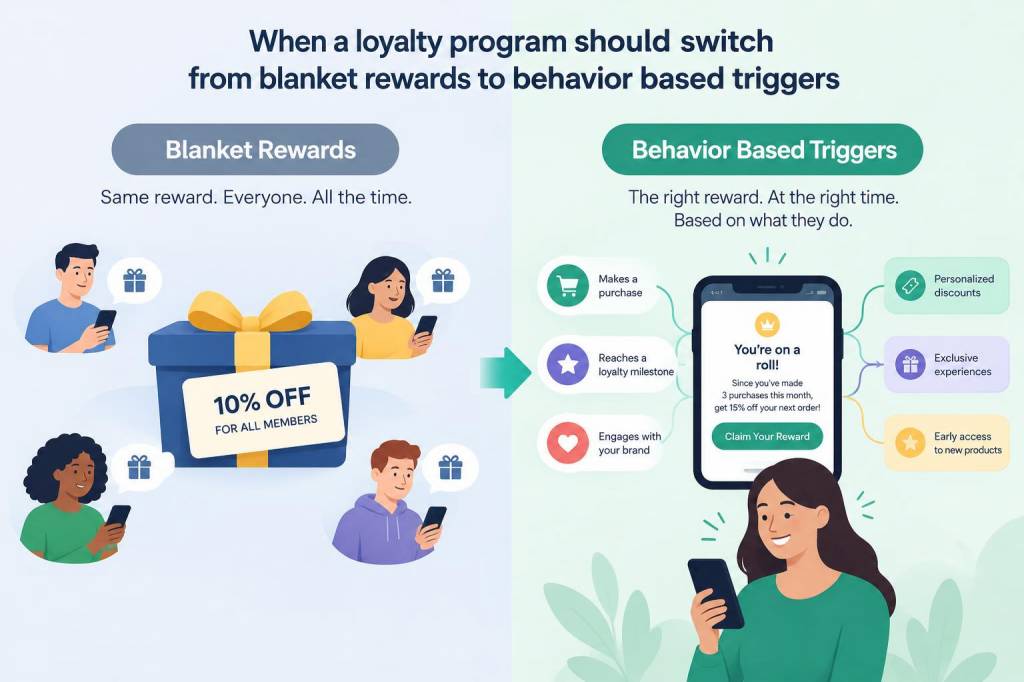
I usually see loyalty programs start with a simple promise: reward everyone, reward often, and make the value easy to understand. That approach works well at first. It creates momentum, reduces friction, and gives customers a clear reason to come back. But at a certain point, blanket rewards can begin to feel expensive, blunt, and oddly disconnected from actual customer behavior. That is usually when I start asking whether a program should move from broad, uniform rewards to behavior-based triggers.
For me, this shift is not about making a program more complicated for its own sake. It is about making rewards smarter. A blanket reward gives everyone the same outcome, regardless of what they do. A behavior-based trigger gives a reward when a customer completes a specific action that matters to the business. That could mean a repeat purchase, a higher basket value, a referral, a review, a birthday visit, a subscription renewal, or a lapse-prevention action. The difference sounds small, but it changes the entire economics and psychology of the program.
Why blanket rewards work at first
I still think blanket rewards have a place. In an early-stage program, they are often the right choice because they are simple to explain, easy to launch, and easy to measure. Customers understand them quickly. Internal teams can manage them without a complex tech stack. Finance teams can forecast them with relative confidence. If I am working with an SME that needs fast adoption and does not yet have enough data to segment customers properly, I often start here.
Blanket rewards are especially useful when a brand is trying to build basic habit formation. If customers are new, uncertain, or not yet emotionally connected to the brand, a consistent reward structure removes hesitation. It lowers the mental effort needed to participate. For example, a café chain offering points for every pound spent, or an online retailer offering a flat discount after a few purchases, creates a clear loop: spend, earn, return.
That said, blanket rewards begin to lose efficiency when customer behavior becomes more varied. Some customers buy frequently but spend little. Others buy rarely but place high-value orders. Some people are loyal without needing much incentive. Others need a nudge only at certain moments. A single reward structure treats all of those groups the same, which is rarely economical.
Signals that it is time to change
When I am reviewing a loyalty program, I look for a few clear signals that a blanket model is reaching its limits.
- Redemption costs are rising faster than incremental revenue.
- High-value customers receive the same reward as low-value customers, even when their contribution is very different.
- The program drives activity, but not the right kind of activity.
- Repeat purchase rate has plateaued, even after discounting.
- Members engage, yet most of the engagement is price-led rather than loyalty-led.
- There is little difference in behavior between enrolled customers and non-members.
- Marketing spend is being used to reward behavior that would have happened anyway.
If several of those patterns are present, I start thinking about triggers. Not because blanket rewards are “bad,” but because they are no longer precise enough. In practical terms, the business is paying for volume rather than value.
I also pay attention to customer lifecycle stage. A new customer needs reassurance. A returning customer needs encouragement. A dormant customer needs reactivation. A loyal customer may need recognition more than discounting. Once those lifecycle differences become visible in the data, a uniform reward structure starts to look wasteful.
What behavior-based triggers actually do
Behavior-based triggers let me connect a reward to a desired action. Instead of saying, “Everyone earns points for shopping,” I can say, “Customers earn something extra when they complete an action that improves retention, margin, or frequency.” That extra precision lets a program support specific business goals.
In practice, I use triggers to do one of four things:
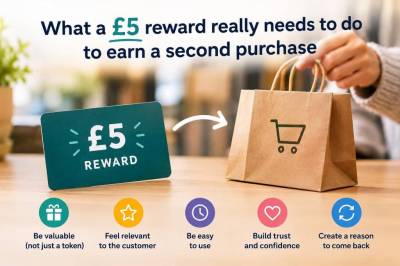
- Increase frequency, such as rewarding a second purchase within a short window.
- Increase basket value, such as offering a bonus after a threshold spend.
- Reduce churn, such as sending an incentive when a customer has gone quiet.
- Encourage advocacy, such as rewarding referrals, reviews, or social sharing.
This is where loyalty becomes more than a discount engine. It becomes a behavior design system. I can reward a customer for moving in the direction I want, rather than simply subsidising all activity equally. That distinction matters a lot when budgets are tight.
The economics behind the switch
From a financial point of view, blanket rewards are easy to budget but hard to optimise. Behavior-based triggers are harder to design but much easier to justify when they are built properly. I often think about three questions:
What action am I trying to cause? If I cannot name the behavior, I should not build the trigger.
What value does that action create? A trigger should align with margin, repeat rate, retention, or long-term value.
What is the cost of the reward compared with the lift? If the reward is too generous, I may buy actions that would not have paid back.
That means I am not just measuring redemptions. I am measuring incremental impact. A trigger may feel more expensive because it is more visible, but it can actually reduce waste. For example, rewarding a customer only when they return within 30 days may cost less overall than giving the same discount to every transaction. The first version targets a behavioral gap. The second spreads cost everywhere.
I also find that behavior-based rewards improve budget control because they create natural rules. If a trigger is tied to a specific event, I can cap it, forecast it, and test it. I can compare triggered members against a holdout group and see whether the reward changed behavior enough to justify itself. That is much harder to do with a blanket reward structure, especially when everything is happening at once.
The customer experience risk I watch most closely
There is one danger with behavior-based triggers: they can become too clever. If customers do not understand why they are receiving a reward, trust starts to weaken. I have seen programs become fragmented because every trigger feels like a different mini-rule. That creates confusion, and confusion kills engagement.
So I keep the experience simple even when the logic behind it is more advanced. The customer should still feel a clean value exchange. In my experience, behavior-based triggers work best when they are presented in plain language and connected to a meaningful milestone. Customers should be able to say, “I did this, so I got that.”
I also try to avoid over-targeting. If every action is monitored and every reward feels conditional, the program can begin to feel transactional in a negative way. Loyalty should feel rewarding, not surveilled. The trick is to use triggers selectively, especially for moments that matter most: reactivation, repeat purchase, referrals, premium behavior, and at-risk customers.
Simple trigger models I like working with
When I help a business move away from blanket rewards, I usually start with a few practical trigger models that are easy to explain and easy to test.
| Trigger type | Behavior | Business goal | Why it works |
|---|---|---|---|
| Frequency trigger | Second or third purchase within a set period | Build habit | Encourages faster repeat behavior |
| Threshold trigger | Spend above a defined basket value | Improve margin | Pushes customers toward larger orders |
| Reactivation trigger | No purchase for a defined period | Reduce churn | Targets likely lapse risk |
| Advocacy trigger | Referral, review, or social action | Grow reach | Turns loyal customers into promoters |
| Milestone trigger | Anniversary, tier upgrade, or status event | Strengthen emotion | Creates recognition beyond price |
I like these because they map cleanly to common SME objectives. They do not require a massive data science team. They do require a clear definition of success and a willingness to test.
What I check before recommending a switch
Before I recommend moving from blanket rewards to triggers, I look at whether the business has enough structural maturity to support the change. A trigger-based program needs a few basics in place: usable customer data, reliable tracking, a clear CRM or email flow, and enough transaction volume to detect patterns.
If a brand cannot identify repeat customers accurately, trigger design becomes guesswork. If reporting is weak, it is hard to know whether the trigger is creating incremental value. If the marketing team cannot automate timing, the trigger becomes operationally expensive. In those cases, I may suggest a phased approach rather than a full redesign.
I also look at customer segmentation. If every member behaves the same, there may not be enough variation yet to justify complex triggers. But if I can already see distinct groups such as high-frequency buyers, seasonal buyers, new joiners, and lapsed members, then behavior-based logic can quickly become powerful.
When I would keep blanket rewards in place
I would not move away from blanket rewards just because behavior-based triggers sound more advanced. If a program is still in its early stage, simplicity may be more valuable than precision. I would also keep a blanket structure if the brand’s offer is naturally low-frequency, if the customer base is very small, or if the business lacks the ability to track behavior accurately.
Another case where I keep blanket rewards is when the reward itself is the core product of the loyalty experience. Some brands rely on broad, immediate value as part of their positioning. In those cases, selective triggers can exist alongside a base reward, but they should not replace the simplicity that customers expect.
For me, the real decision is not blanket versus triggers. It is whether the current reward structure still matches the customer lifecycle, the data maturity, and the commercial goals of the business. Once those three drift apart, I know it is time to redesign.
What usually convinces me most is when I can see that a program is rewarding presence rather than progress. That is the turning point. At that stage, I want the loyalty logic to follow behavior more closely, because that is where the strongest return usually lives.
And when I am shaping that move, I keep returning to a simple question: which customer action deserves a reward because it changes the future of the relationship, not just because it happened?