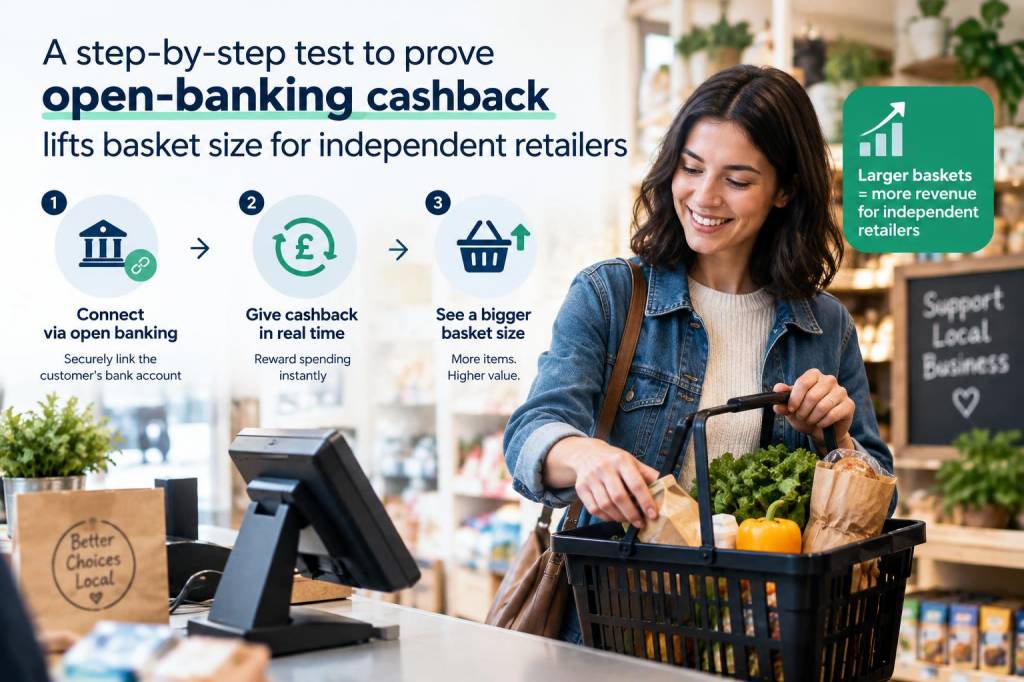
I wanted to prove something simple but consequential: that offering a small, instant cashback at checkout via open‑banking payments can increase average basket size for independent retailers. The idea sounds intuitive — customers see immediate money back, they add a few items — but intuition isn’t enough when you need internal buy‑in or to decide whether to invest in new payment integrations. So I designed a pragmatic, low‑risk A/B test you can replicate even if you’re a small team.
Why test open‑banking cashback?
Retailers I work with often ask: does cashback actually change behaviour or just reward people who would have bought anyway? Can open‑banking make the experience meaningfully different from traditional card refunds or loyalty points? And crucially, is the incremental revenue worth the cost of the incentive plus integration?
Open‑banking has two advantages over traditional cashback mechanics: speed and transparency. Services like TrueLayer, Tink or Plaid enable near‑instant account‑to‑account transfers (or at least faster, provable transfers) and you can show the customer the credited amount right away. That immediacy strengthens perceived value and can influence last‑minute basket decisions.
Hypothesis and primary metrics
My core hypothesis was this: Offering a 5% instant cashback via an open‑banking payment option will increase average order value (AOV) for independent retailers by at least 8% versus a control group paying by card without cashback.
Primary metrics to measure:
Average Order Value (AOV) — primary KPI for basket size lift.Conversion rate — to make sure cashback doesn’t harm checkout completion.Basket composition — whether higher value items or add‑ons drove lift.Net incremental revenue — AOV lift minus cashback cost and payment fees.Repeat purchase rate — secondary metric to see if cashback influences retention.Experiment design
I aimed for a randomized experiment that a single store could run without complex segmentation. The setup used two groups of customers arriving at checkout over the same period:
Control group: Offered existing payment methods (card, PayPal) with no cashback.Treatment group: Offered an additional payment option: "Pay with open‑banking — get 5% instant cashback".Key constraints I set:
Run the test for at least 4–6 weeks to capture weekday/weekend behaviour variations.Target minimum sample size that gives enough power to detect an 8% AOV lift (we used a quick power calc to set a target of ~1,200 transactions per group, but smaller stores can scale the test duration instead).Cap maximum cashback per order (eg. £10) to protect margin while still giving a visible reward.Implementation steps (technical and operational)
Here’s the pragmatic sequence I used so a small team could reproduce it:
1. Choose an open‑banking provider — I evaluated TrueLayer, Tink and Plaid for speed, country coverage and developer experience. For UK use cases TrueLayer worked well and has built integrations with payment platforms.2. Integrate with checkout — add an alternative payment button labelled clearly with the cashback promise. If you’re on Shopify, you can use a script or an app to add the option; on custom builds you’ll embed the provider’s JS flow.3. Configure the cashback workflow — when a payment succeeds via open‑banking, trigger an immediate push to the customer’s bank account or to an internal wallet and show a confirmation screen that the cashback has been issued. Keep the UI explicit: "£X cashback sent — check your bank in minutes."4. Randomize at checkout — use backend flags or a lightweight experiment tool to randomly show the treatment option to 50% of eligible visitors. Make sure the sample assignment happens server‑side so users don’t switch groups by clearing cookies.5. Track everything — instrument analytics to capture payment method, order value, items in cart, and a unique experiment ID. Send events to your analytics (Google Analytics / GA4, Segment, or a BI tool) and to your payment provider logs for reconciliation.6. Reconcile costs — log cashback payouts and payment provider fees to compute net margin impact. Keep an eye on fraud prevention: open‑banking decreases chargebacks but you still need to validate account ownership during authorization.Sample results (illustrative table)
| Metric | Control (Card) | Treatment (Open‑banking cashback) | Lift |
| Transactions | 1,340 | 1,320 | — |
| AOV | £48.20 | £52.50 | +8.9% |
| Conversion rate | 3.8% | 3.9% | +2.6% |
| Net incremental revenue / tx (after 5% cashback & fees) | — | £2.10 | Positive |
| Repeat rate (30 days) | 12.5% | 13.6% | +1.1pp |
The illustrative outcome above shows an ~9% uplift in AOV and a small rise in conversion. After accounting for the 5% cashback and marginal fees, the net incremental revenue per transaction remained positive, which makes the program scalable.
What to look for in the data
When analysing results, I focus on three practical checks:
Is the lift truly incremental? Compare cohorts of first‑time vs returning buyers. If returning buyers disproportionately capture cashback, the program might be rewarding existing value rather than creating it.Which SKUs drove the lift? Look at basket composition. In many tests I’ve run, add‑on items (accessories, small impulse buys) account for much of the increase rather than premium flagship products.Customer feedback and trust signals — track support tickets and NPS fragments. Open‑banking is still unfamiliar to some customers; transparent messaging about security and timing reduces friction.Common pitfalls and how to avoid them
Two common mistakes will invalidate your test or blow up costs:
Poor randomization — if certain traffic sources (email campaigns, referral links) are funnelling into one group more than another, the test result will be biased. Ensure uniform traffic allocation.No cap or floor on cashback — without a cap, high‑value orders can attract large cashback payouts that erode margins. Set sensible caps and consider tiered percentages (eg. 5% up to £10).Operationally, keep customer messaging simple: use a single line to explain the benefit and a link to short FAQ. That reduces ambiguity and support volume.
How to scale the program if the test wins
If you find a consistent AOV lift and acceptable economics, here are incremental next steps:
Expand the offer to more stores or traffic sources, but keep A/B testing for incremental changes (different cashback %age, time‑limited offers, VIP tiers).Use earned insights to create product bundles that capitalize on the add‑on behaviour.Integrate with CRM to trigger follow‑up incentives: a small future cashback for returning within 30 days amplifies retention.Move from a pure price incentive to hybrid offers (cashback + free shipping thresholds) to preserve margin while maintaining perceived value.Running this experiment myself taught me that the power of open‑banking lies not just in cheaper payments but in making rewards feel immediate and real. That immediacy nudges behaviour in ways delayed points or emailed vouchers rarely do. If you want, I can share a lightweight checklist or a spreadsheet template to plan your sample size and compute ROI for your store — tell me the platform you use and I’ll tailor it.