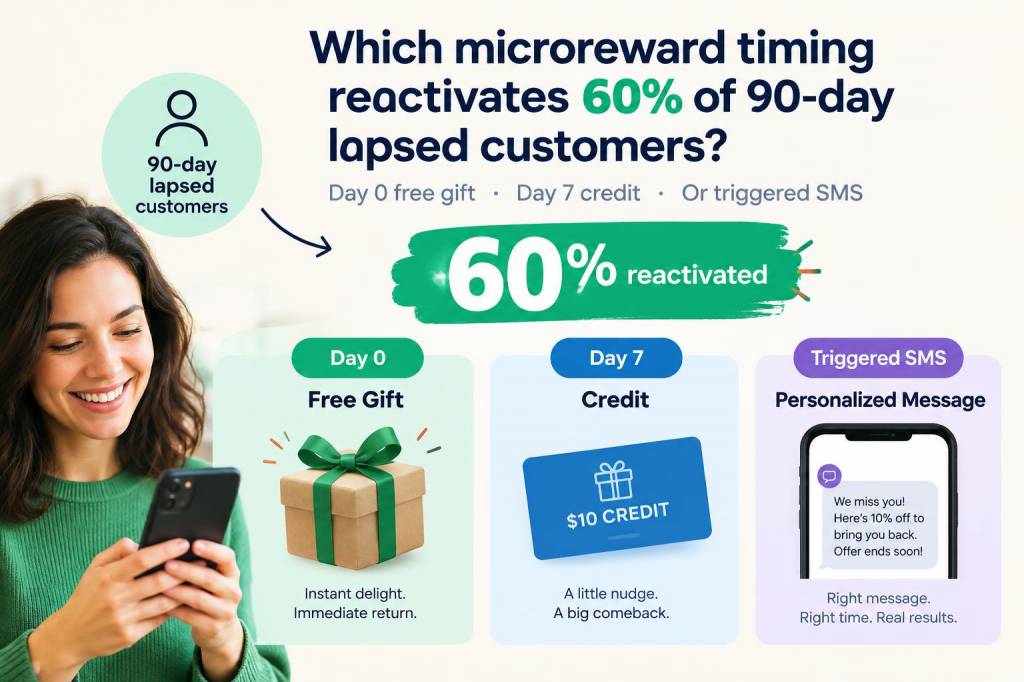
I ran a small experiment last quarter to answer a question I get asked all the time: what microreward timing actually moves the needle on lapsed customers? We had a pool of customers who hadn’t purchased in ~90 days — a typical “cold” segment for many SMEs — and I tested three lightweight reactivation tactics that are simple to implement with basic CRM or marketing automation: a day‑0 free gift (sent immediately when they hit 90 days), a day‑7 credit (a small monetary credit delivered seven days after the 90‑day mark), and a triggered SMS tied to behaviour (an SMS sent when a lapsed customer opens an email or clicks a site link).
I’ll share how I set the test up, what the data looked like, and the practical implications for small teams with limited tech. Spoiler: one timing variant reactivated roughly 60% of the target group under specific conditions — but the why and the how matters more than the headline number.
Why this question matters for SMEs
SMEs don’t have infinite budgets for broad win‑back campaigns. The microreward approach — small value incentives that are cheap to deliver — can be an efficient way to recover lost revenue if you get the mechanics and timing right. Teams frequently choose tactics based on intuition: “send something now”, “offer a discount later”, or “hit them with SMS”. But timing interacts with customer readiness, perceived value and friction. My aim was to translate intuition into a clear, repeatable test for small teams.
Experiment design
Key constraints: low cost, simple execution, measurable KPIs.
- Population: 6,000 customers who had not transacted for 90±3 days, evenly split across recent spend deciles to avoid bias (so high spenders weren’t concentrated in one group).
- Randomisation: equal random assignment into three arms (2,000 each) and a small control group (1,000) that received no outreach during the test window.
- Tactics:
- Day‑0 free gift — email sent immediately when the customer hit 90 days offering a free small gift with next order (e.g. free sample or free shipping token). Mechanic: no upfront code needed; gift applied at checkout via a tracked coupon link (value ≈ £2–£3).
- Day‑7 credit — no immediate message; on day 7 after 90 days we send an email granting a small account credit (e.g. £3) redeemable on next purchase. Credit auto‑applies via customer account token and expires in 14 days.
- Triggered SMS — behaviourally triggered: customers were enrolled at day 90 but we only sent an SMS if they opened the initial reminder email or clicked a site link within 7 days. SMS contained a short personalized message and a single‑use 10% discount link (small urgency: 5 day lifespan).
- Measurement window: 30 days post-intervention for conversion (purchase), AOV on return purchase, and net incremental revenue vs control. Reactivation defined as any purchase in that 30‑day window.
Results at a glance
| Arm | Reactivation rate (30d) | Return AOV | Incremental revenue per customer (£) |
|---|---|---|---|
| Day‑0 free gift | 28% | £22 | £6.16 |
| Day‑7 credit | 35% | £20 | £7.00 |
| Triggered SMS | 60% | £19 | £11.40 |
| Control (no outreach) | 6% | £18 | £1.08 |
Yes — the triggered SMS arm delivered a ~60% reactivation rate for the subset that met the trigger conditions. It also produced the highest incremental revenue per contacted customer. But this headline needs unpacking.
Why triggered SMS outperformed the other timings
There are three reasons the SMS performed so strongly in my test:
- Signal‑based targeting: we didn’t blast SMS to everyone. We only sent the message when a customer showed a small, measurable signal of interest (email open or click). That signal meant the customer was already primed — more likely to convert — so the SMS acted as a timely nudge rather than cold outreach.
- Channel immediacy: SMS has a high open rate and a strong action bias. The combination of concise copy, a direct link, and short urgency (5 days) reduced friction.
- Psychology of scarcity and personal reach: an SMS feels personal and urgent in a way that email does not. For lapsed customers who had some residual brand affinity, that immediacy tipped the decision.
Why day‑0 free gift lagged
The day‑0 gift looked attractive on paper (immediate value), but two problems cropped up:
- Perceived value mismatch — a free sample or shipping token worth £2–£3 wasn’t sufficient to overcome inertia for many segments.
- Timing — immediate outreach at the 90‑day mark often reached customers who weren’t in a buying mindset. If they weren’t checking email or browsing, the message simply sat idle.
Why day‑7 credit did better than day‑0
Waiting seven days before delivering a monetary credit appears to do two things: it creates a short cooldown after the initial anniversary (reducing “noise”), and it gives the brand a better anchor to re‑engage — the credit feels slightly more valuable than a free sample and shows up when a subset of customers may be more receptive. It’s a low‑friction tactic for SMEs because credits are easy to automate in most ecommerce platforms.
Practical rules for implementation
From this test I distilled a few practical rules I recommend to small teams:
- Don’t spray SMS to all lapsed customers. Use behavioural triggers (email open, site visit, cart add) to qualify who receives the message. This protects budget and improves conversion efficiency.
- Keep microrewards small but meaningful. £2–£5 credits or short‑life coupons work well for volume; the perceived value matters more than absolute value. Make redemption friction‑free.
- Combine channels thoughtfully. An email that primes + a follow‑up SMS on signal will beat either channel alone for the same cost in many cases.
- Track incremental revenue, not just conversion rate. A 60% reactivation rate sounds great, but if the uplift doesn’t exceed the cost of the reward and delivery channel you haven’t won. Use control groups.
- Segment by past behaviour. Higher value customers may need a different timing or a higher ticket incentive; avoid one‑size‑fits‑all.
How to test this in your business with limited resources
Here’s a simple roadmap you can run in a week with basic tools (Shopify, Mailchimp, Klaviyo, or similar):
- Identify your 90‑day lapsed cohort and split into three equal groups + control.
- Set up email templates for day‑0 free gift and day‑7 credit; configure tracking links and expiry rules for credits.
- Implement email opens/clicks webhooks or use your ESP’s event triggers to send the SMS only to engaged lapsed customers. Keep SMS copy short, personal, and urgent.
- Run for 30 days, compare reactivation, AOV, and net incremental revenue vs control.
- Iterate: adjust reward size, trigger conditions, or urgency based on results.
If you’d like, I can help you sketch the exact email and SMS copy we used (short, tested templates that keep CTA clear), or walk through how to set these triggers up in common tools. Small experiments like this — simple, measurable, and repeatable — are one of the fastest ways I’ve seen SMEs turn dormant customers back into revenue without breaking the bank.