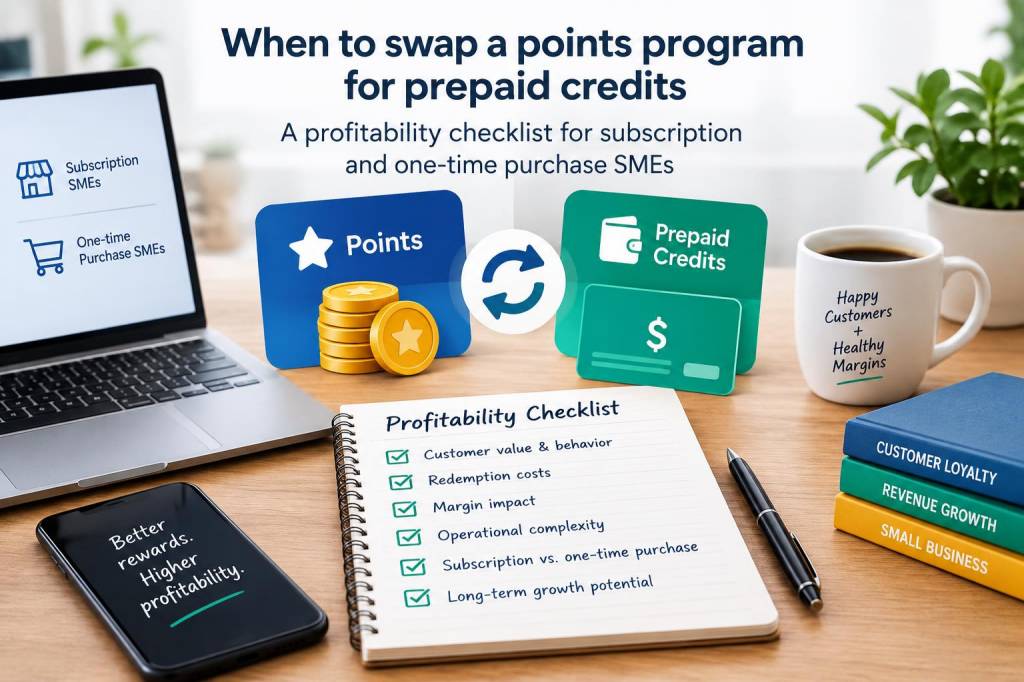
I often get asked by founders and marketing heads whether they should keep their familiar points-based loyalty scheme or move to a prepaid credits model. It's a common dilemma for SMEs running subscription products or selling one-off purchases. I’ve seen both systems work — and fail — depending on product margins, purchase frequency and how easily customers understand the value exchange. In this post I’ll walk through a practical profitability checklist I use to decide when swapping points for prepaid credits makes sense, with the metrics and experiments you can run before you commit.
Why the choice matters
Points programs are popular because they feel generous, are flexible, and can be gamified. But they also introduce complexity: breakage assumptions, tricky accounting, and often low perceived cash value. Prepaid credits (store credit, digital wallets or gift-balance models) convert loyalty into a simpler, cash-equivalent instrument that can improve redemption clarity, retention and cash flow — if done right.
From a profitability perspective, the choice affects three levers:
When prepaid credits typically outperform points
Switch to prepaid credits when several of the following are true for your business:
When to keep points (or hybrid)
Points still win when you want to:
Profitability checklist: data you need
Before you decide, run this checklist. Collect the numbers, run simple scenarios and use the thresholds I outline as rules of thumb. These are not universal but are practical starting points.
| Metric | What to measure | Rule-of-thumb threshold |
|---|---|---|
| Repurchase frequency (30/90/365-day) | Percentage of customers who buy again within time windows | Retention > 30% at 90 days → credits likely beneficial |
| Average order value (AOV) | Mean transaction value for loyalty customers vs non-loyal | AOV < £40 and margin > 40% → credits to drive volume |
| Gross margin on incremental sales | Contribution margin on purchases driven by loyalty | Incremental margin > cost of credits (incl. discounts) → positive |
| Breakage rate | Share of issued points/credits never redeemed | Points breakage > 40% often masks poor perceived value |
| Customer support load | Queries per 1k customers about points issues | High support load → credits to reduce friction |
| Liability on balance sheet | Outstanding points value vs revenue | Liability > 5% of revenue → revisit program design |
Quantify the economics: a simple model
Build a one-page P&L for your loyalty mechanics. Key inputs:
Example: 10,000 customers, each receives £1 equivalent per month. If credits drive a 15% uplift in purchase frequency and incremental margin on that uplift is 50%, the program can be profitable even if redemption is high because each redemption generates gross margin. With points, perceived value may be lower, meaning you might issue more points to get the same behavioral lift — increasing liability without equivalent benefit.
Design considerations when swapping to credits
If the checklist points you toward credits, be mindful of these design choices to protect margin and customer trust:
Tests you can run before a full switch
Don’t flip the switch overnight. Run controlled experiments:
When I help clients make this change, the most common mistake I see is under-estimating communication effort. Customers need to understand the shift, the benefits and any conversion rates if you migrate existing points to credits. Be transparent, offer conversion bonuses when relevant, and provide customer-facing examples ("£10 credit buys X").
If you want, I can share a simple spreadsheet template to model your numbers and run these scenarios. It’s the easiest way to see whether credits improve your bottom line or simply shift the accounting around.
