I ran an A/B test in a small boutique ecommerce store to answer a question I get asked all the time: for growing SMEs, which incentive moves the needle more — free shipping or a discount coupon? The brand was a UK-based boutique selling apparel and accessories with average order value (AOV) around £48, relatively low margins and a steady flow of repeat customers. We needed a clear, measurable answer to optimise promotions without eroding long-term value.
Why this test mattered
On paper both offers look attractive. Free shipping removes a psychological barrier at checkout and can reduce cart abandonment. Discount coupons directly improve the perceived bargain and can increase units per order. But the financial mechanics differ: discounts cut margin directly; free shipping can be absorbed into pricing or minimum thresholds. For an SME with thin margins, the right choice can be the difference between profitable growth and costly acquisition.
How we designed the experiment
My objectives were simple and measurable:
- Primary metric: conversion rate during the promotional period (session to order).
- Secondary metrics: average order value (AOV), gross margin per order, repeat-purchase rate within 60 days, and cost per incremental order acquired.
Key constraints:
- Traffic volumes were modest — about 10k sessions/month across channels. We needed at least two weeks per variant to gather meaningful data.
- We wanted to isolate the effect of the offer, so creative and messaging were kept identical aside from the offer copy and the checkout experience for the free shipping variant.
- We excluded existing loyalty members (who often receive custom offers) to avoid contamination.
The test arms were:
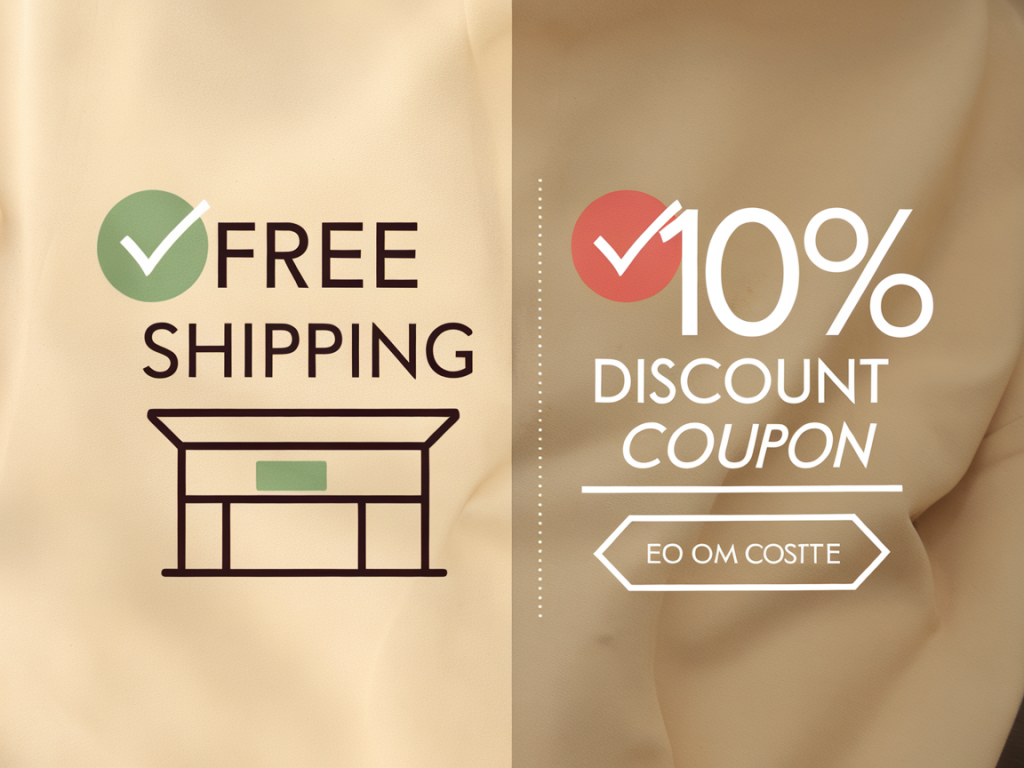
- Free shipping: sitewide free shipping for all orders during the test period (no minimum threshold), promoted site banner, cart-level message and free-shipping badge on PDPs.
- Discount coupon: 10% off using code SAVE10, promoted in the same locations and with the same creative emphasis.
Why 10%? It aligned with past promotional norms for the brand and felt realistic. We also ran a short pre-test to check that site performance and checkout flows were stable.
What we measured and how
All events were tracked via Google Analytics and the platform's native order reporting. I set up cohort and funnel reports to ensure we captured whether the incentive changed behaviour earlier in the funnel (product page -> add-to-cart) or at checkout.
| Metric | Why it matters |
|---|---|
| Conversion rate | Primary signal of whether the offer reduced friction |
| AOV | Indicates whether customers increased spend to qualify or to capitalise on the deal |
| Gross margin per order | Shows true financial impact after shipping cost or discount applied |
| Repeat purchases (60-day) | Measures longer-term retention effect of each incentive |
| Cost per incremental order | Combines sales uplifts with margin impact to show acquisition efficiency |
Results — the headline numbers
After running the test for three weeks (to cover weekday and weekend behaviours), here’s what we saw. Sample sizes were roughly balanced: ~7,200 sessions per arm, ~220 orders for free shipping, ~190 orders for discount code.
| Metric | Free shipping | 10% discount |
|---|---|---|
| Conversion rate | 3.06% | 2.64% |
| AOV | £46 | £53 |
| Gross margin / order | £6.20 (after average shipping cost) | £4.80 (after discount) |
| Repeat purchases (60d) | 12.3% | 8.9% |
| Incremental orders vs baseline | +18% | +2% |
Quick interpretation: free shipping produced a higher conversion rate and more incremental orders, while the discount increased AOV but eroded margin more heavily. Crucially, free shipping also correlated with a higher repeat-purchase rate in the short term.
What I learned — behavioural and financial takeaways
- Free shipping removes friction at the point of purchase. In this store, shipping was a top-cited reason for cart abandonment during on-site surveys. Removing that barrier led to quicker purchase decisions, especially for lower-AOV carts typical of this brand.
- Discounts incentivise larger baskets but at a margin cost. Customers reacted to 10% off by adding more items; AOV rose by about 15%. But because the product margins were thin, the net profitability per order decreased more under the discount than under free shipping.
- Perception of value matters differently. Free shipping is seen as an operational improvement (I don’t have to pay extra) while a small percentage discount translates into price competition. The latter can condition customers to wait for discounts.
- Free shipping can drive retention. We saw a higher short-term repeat rate with free shipping. My hypothesis: customers who experienced low-friction checkout associated the brand with convenience, increasing likelihood to return.
- Offer framing and thresholds change the calculus. This test used no minimum for free shipping. A minimum spend (e.g. free shipping over £60) would likely lift AOV further and protect margin. Conversely, percent discounts above a basket threshold or on specific SKUs can be more margin-friendly.
Practical rules I applied after the test
Based on the findings I suggested and implemented the following changes:
- Keep a sitewide free-shipping promotion only for short, strategic windows (brand awareness pushes, acquisition campaigns), but introduce a minimum threshold of £60 for regular use to protect margin.
- Use targeted discount coupons for cart recovery and VIP segments where margin sacrifice is justified: e.g. 10% off for lapsed customers with a minimum spend rather than sitewide codes that train all buyers.
- Promote free-shipping as a membership perk within a simple loyalty layer: customers who sign up to email receive free shipping for 30 days. This drove email capture and increased CLTV without making free shipping the default for everyone.
- Instrument follow-up campaigns to track whether the incentive produced high-value repeat customers or low-margin one-offs, and tag orders accordingly in the CRM.
What to watch for when you run this yourself
My experience came with caveats that are worth flagging:
- Test duration and sample size matter. Small stores need longer windows to capture real patterns and avoid one-off spikes (e.g. social referral).
- Traffic source mix can change outcomes. Paid channels often respond better to discounts; organic/search may respond more to free shipping. Segment results by channel.
- Shipping economics are unique. Know your average shipping cost per parcel and margin per SKU. An apparently small shipping cost can kill profitability on cheap items.
- Consider customer lifetime value (CLTV). Short-term margin loss might be acceptable if the offer attracts higher-LTV customers — which is why tracking cohorts is essential.
How I would iterate next
Experiments don’t stop at one A/B test. My next steps would be:
- Test free shipping with a threshold (£60) vs a tiered discount (5% over £40, 10% over £80) to see which nudges basket-building most efficiently.
- Run channel-specific variants: free shipping for organic visitors, targeted discount codes for paid traffic, to align spend with channel economics.
- Introduce membership-style free shipping (paid or earned) and test its impact on repeat frequency and retention cohorts over 6–12 months.
- Combine offer tests with product merchandising (e.g. bundle items to push customers to thresholds) and measure incremental margin per session, not just per order.
What the test confirmed for me is a simple principle I apply when advising SMEs: incentives must be judged by the entire economics they trigger — conversion, basket size, margin and future behaviour — not just by the immediate uplift in orders. For many boutique merchants, strategically-implemented free shipping can deliver more profitable growth than blanket discounts, but the optimal approach depends on price points, shipping costs and customer expectations. Run controlled tests, segment your results, and design the second test based on what the first one taught you.