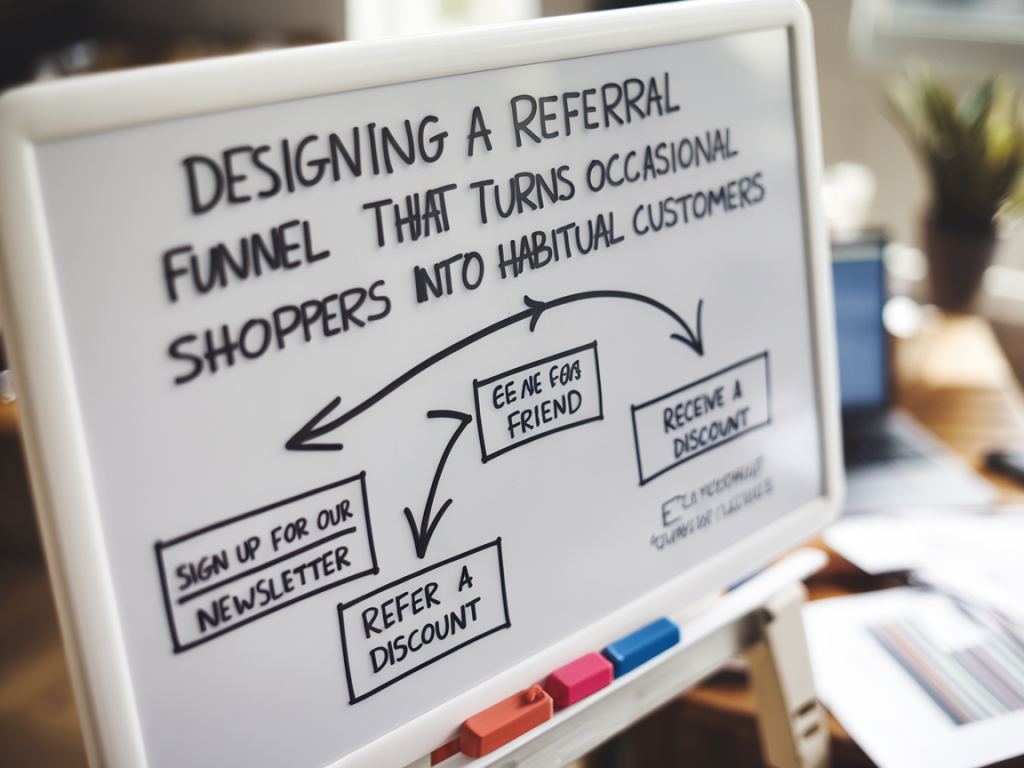
I’ve run referral tests for dozens of small and mid-sized brands, and one lesson keeps coming back: a referral program that only brings new customers isn’t enough. If you want referrals to be a repeatable growth channel, the funnel must be built to turn those occasional shoppers into habitual customers. That means thinking beyond “get a friend to buy” and designing the end-to-end journey — from the moment a customer clicks “refer” to the point where they become a loyal buyer who refers again.
Why a referral funnel needs to be more than a reward
Most teams focus on the incentive — discount codes, free products, bonus points — and hope the rest will follow. In reality, incentives are just the starting point. A strong referral funnel aligns incentives with activation, onboarding, and retention mechanics so the referred customer experiences value quickly and the referrer feels rewarded in a way that encourages repeat sharing.
When I audit programs I look for four failure modes: friction in sending a referral, vague value for the referred customer, no onboarding for first-time buyers, and lack of measurement for repeat behaviour. Fixing these elements is how you turn one-off referred orders into lifetime value.
Designing the funnel: the stages I build
I break the referral funnel into clear stages. For each stage I define the objective and the minimum viable mechanics to test.
Trigger — the action that makes a customer want to share (e.g., an outstanding purchase experience or a loyalty milestone).Send — the actual referral step. This must be fast and low-friction (one or two clicks).Acquire — the referred customer converts. The offer must be clear and valuable to them.Onboard — the first experience post-purchase that accelerates habit formation.Retain — the programme that nudges both referrer and referee to transact again.Measure & Optimise — track LTV, repeat purchase rate and referral re-use to validate the loop.Practical mechanics I use at each stage
Below are concrete mechanics I implement when building a referral funnel for an SME. You don’t need fancy platforms to start — many of these are achievable with existing e‑commerce tools, email automation and a tiny bit of code.
Trigger: Use moments of delight — order confirmation with a handwritten note, unboxing email, order arriving on time, or a loyalty milestone (e.g., after fifth purchase). Prompt customers to share when their sentiment is highest.Send: Provide multiple easy channels: shareable link, pre-filled SMS, social post templates and email forward. Keep copy short and social-friendly: “Save 15% on your first order — from me, at [brand].”Acquire: Make the first-order offer clear and immediate — time-limited discount plus free shipping removes hesitation. Avoid offers that cannibalise full-price purchases (e.g., 50% off a flagship product is usually too aggressive).Onboard: Send a dedicated onboarding email sequence for referred customers: welcome note, best-sellers, how-to content, and an early cross-sell with low friction (e.g., “Try this refill subscription with 10% off”). The goal is meaningful second-order behaviour within 30 days.Retain: Use double-sided incentives where possible (both referrer and referee benefit). Reward referral re-use — smaller but recurring rewards (store credit, points) work better than one-off gifts for encouraging continued sharing.Measure & Optimise: Track cohorts of referred customers vs. organic customers across key metrics: 30/90/365-day repeat purchase rate, average order value (AOV), and LTV. Also monitor referral reuse rate — how many referrers send more than one invite?Simple template: a referral email funnel I use
Here’s a short sequence you can implement without a loyalty platform. Use your email system and a bit of URL tracking.
| Trigger email (post-purchase, day 3) | “Loved your order? Share 15% with a friend — get £5 when they buy” + share buttons |
| Follow-up (day 10) | Reminder + highlight top product referrers love + 1-click share |
| Referee welcome (immediate) | Welcome note, how-to-use guide, product bundle suggestion with 15% off |
| Post-first-order nurture (day 7 after referee’s purchase) | Cross-sell email + small-time-limited discount to drive second order |
| Referrer reward nudge (when referee purchases) | Congratulate referrer + credit details + “share again” CTA with social templates |
Key metrics I insist on tracking
Many teams stop at number of referred conversions. I insist on the following:
Conversion rate of sent invitations — how many invites become clicksReferee first-order conversion rate — how persuasive is the offer30/90-day repeat purchase rate for referees — core indicator of habit formationAverage order value (AOV) comparison — are referees buying strategically or bargain-hunting?Referral reuse rate — percent of referrers who send a second inviteCost per incremental LTV — not just CPA, but the acquisition cost divided by incremental lifetime valueSmall experiments that move the needle
I recommend running 2–3 small A/B tests early. Here are experiments that consistently deliver results for SMEs:
Offer structure: Test discount to referee only vs. double-sided credit (both referrer and referee). Double-sided tends to increase reuse.Timing: Test triggering the invite on order confirmation vs. delivery confirmation. For product categories with emotional unboxing (beauty, gourmet food), delivery triggers outperform.Onboarding flow: Test a simple “how-to” email vs. a bundle offer aimed at driving a second purchase. The bundle offer often lifts 30-day repeat by 10–20%.Common pitfalls and how I fix them
When referral programs fail, it's usually for predictable reasons. Here’s how I address them:
High friction to share: Fix: reduce steps, pre-fill messages, add social templates.Poor referee experience: Fix: make the first experience irresistible — clear value, fast shipping option, helpful onboarding content.Rewards that don’t motivate repeat behaviour: Fix: shift to smaller recurring rewards (points or store credit) instead of big one-offs.Not measuring LTV: Fix: tag referral cohorts and track purchases for at least 90 days before judging success.If you’re building or tweaking a referral funnel, aim for small, measurable changes: a lower-friction share flow, a more compelling onboarding sequence for referees, and a reward structure that encourages repeat sharing. I document tested playbooks and benchmarks on Zynrewards Co (https://www.zynrewards.co.uk) — if you want a quick audit, I’ll review your funnel and give a two-page action plan you can implement in days.