Loyalty Programs

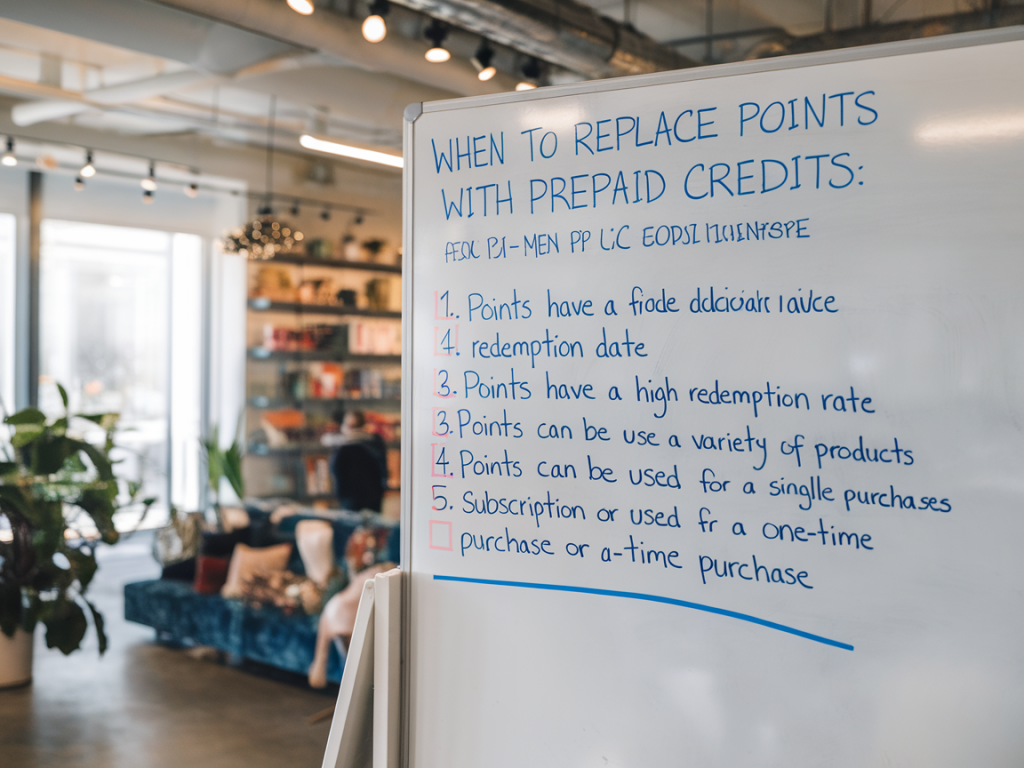
When to replace points with prepaid credits: a decision test for subscription and one‑time purchase businesses

When to replace points with prepaid credits: a decision test for subscription and one‑time purchase businesses

I’ve run and advised enough loyalty programmes to see the same debate pop up over and over: should you reward customers with points that convert into discounts, or give them prepaid credits (store credit, cash-like balances) they can spend directly? The right choice isn’t ideological—it’s practical. Points are powerful for acquisition and repeat purchase psychology; prepaid credits are often better at driving immediate revenue and simplifying redemption. In this piece I’ll walk you through a decision test I use with clients—both subscription and one-time-purchase businesses—so you can choose (or decide to test) the right currency for your customers and your commercial goals.

Why the distinction matters

Points feel aspirational. They let you create tiers, gamify behaviour, and nudge longer-term engagement. But they can be abstract and add friction: customers might forget points exist, or not reach the threshold required to redeem. Prepaid credits behave like money. They’re simpler to understand, tend to be spent sooner, and show up in your accounting differently (often as store credit liabilities). The wrong choice can cost you either in unused liabilities or missed opportunities to activate buyers.

Start with the commercial question

Before diving into UX or tech, I ask founders two commercial questions:

  • What do you most need from your loyalty currency right now—acquisition, retention, or immediate revenue?
  • What behaviour are you trying to change—more frequent purchases, higher AOV, longer subscription life?
  • If your priority is quick sales and reducing churn in a subscription product, prepaid credits often win. If you’re building a long-term emotional relationship or want to introduce tiers and status, points can be better. The remaining sections turn that intuition into a testable decision framework.

    The decision test (three checkpoints)

    Run this quick test for each customer segment (new, active, lapsing):

  • Checkpoint 1 — Clarity & intent: Does the customer need a clear, cash-like incentive to act? If the behavioural trigger you need is "buy now" or "prevent churn this billing cycle", prepaid credits usually work better. Points are stronger when the aim is to build habits over months.
  • Checkpoint 2 — Redemption horizon: What’s the typical time between earning and spending? If your typical interval is shorter than 30–60 days (e.g., weekly shopper or monthly subscription), prepaid credits convert faster. If the horizon is longer (customers who buy seasonally), points give you more runway to influence future behaviour.
  • Checkpoint 3 — Economics & leakage tolerance: How do you value unredeemed currency? Points with vague conversion rates can create liability that’s hard to forecast. Prepaid credits are visible and usually redeemed, but that can mean immediate margin pressure. If your finance team prefers predictable breakage, neither is perfect—but the answer guides whether you should prioritise points breakage or credit liability forecasting.
  • How this applies to subscription businesses

    Subscriptions change the calculus because you can influence recurring behaviour more directly.

  • When to prefer prepaid credits: If churn is your primary pain point and you want to retain customers at the next billing date, offering credits to reduce the upcoming invoice is highly effective. A £5 credit applied to the next month feels immediate and practical; it reduces friction to stay.
  • When to prefer points: If your goal is to increase lifetime value by encouraging upgrades, referrals, or ancillary purchases over time, a points system with tiered benefits can create perceived status and motivation to move up a tier.
  • Practical example: a meal-kit subscription I worked with used a £10 prepaid credit as a churn rescue (offered when customers attempted cancellation). They saw a 25% reduction in immediate churn for those offers, compared with a points-based offer equivalent that had a far lower rescue rate because customers mentally discounted the value.

    How this applies to one-time purchase businesses

    For e-commerce or retail, the decision hinges on purchase frequency and average order value (AOV).

  • Prepaid credits shine when: You have repeat shoppers with short purchase cycles (fashion basics, grocery) or when you want to convert abandoned carts. Credits are also useful for gift cards and refunds—customers quickly reintegrate them into purchase flows.
  • Points shine when: You sell big-ticket or infrequent items and want to cultivate brand loyalty over months (luxury goods, high-end appliances). Points can be combined with tiers and experiential rewards to deepen emotional loyalty.
  • Case in point: a direct-to-consumer mattress brand introduced a points programme to encourage referrals and content sharing; the points model supported these non-transactional actions better than credits would have.

    Operational & UX considerations

    Switching currency is not just marketing—it's product, legal and finance work. Key implementation pitfalls I always flag:

  • Make visibility trivial: show balances prominently in the account, on checkout, and via email reminders.
  • Keep redemption rules simple: prepaid credits should be usable at checkout with no confusing thresholds; points should have clear conversion and expiry rules.
  • Account for tax and accounting: prepaid credits are often treated as deferred revenue; talk to finance and your accountant about liabilities and recognition.
  • Plan migration carefully: if moving from points to credits, avoid surprising customers. Offer conversion incentives (e.g., convert points to credits with a small bonus) to maintain trust.
  • KPIs to watch during a trial

    Run a time-bound A/B test and track:

  • Redemption rate (how many customers use the currency)
  • Time-to-redemption (days between earning and using)
  • Incremental revenue (how much additional spend is driven)
  • Retention or churn rate (for subscriptions)
  • Average order value (do credits incentivise higher or lower basket sizes?)
  • Customer satisfaction / NPS changes (do customers report higher clarity and value?)
  • Metric Credit-favouring signal Point-favouring signal
    Redemption rate High (>30%) Low (<15%)
    Time-to-redemption <60 days >90 days
    Impact on churn Immediate reduction Delayed / long-term uplift

    Final practical tips

    If you can’t choose globally, segment. Use prepaid credits for behaviour with short horizons (abandoned carts, cancellation saves, subscription next-bill incentives) and points for long-horizon relationship building (tiers, referrals, status). When migrating, be generous and transparent: customers respond better to a clear conversion with a small bonus than to an unexplained shift.

    Changing your loyalty currency is a lever, not a magic bullet. The best outcomes come from matching the currency to the behaviour you need now, instrumenting it with the right KPIs, and being ready to iterate based on real customer response.


    You should also check the following news:

    How to calculate the exact welcome bonus for a £250 average order value so it pays back within three purchases
    Loyalty Programs

    How to calculate the exact welcome bonus for a £250 average order value so it pays back within three purchases

    I often get asked a deceptively simple question: “How big should our welcome bonus be if our...

    Jun 23 Read more...
    Swap generic points for behavioural nudges: a step‑by‑step test to lift month‑two retention
    Customer Retention

    Swap generic points for behavioural nudges: a step‑by‑step test to lift month‑two retention

    When I audit loyalty programmes for SMEs, one pattern keeps repeating: brands offer generic points...

    May 17 Read more...