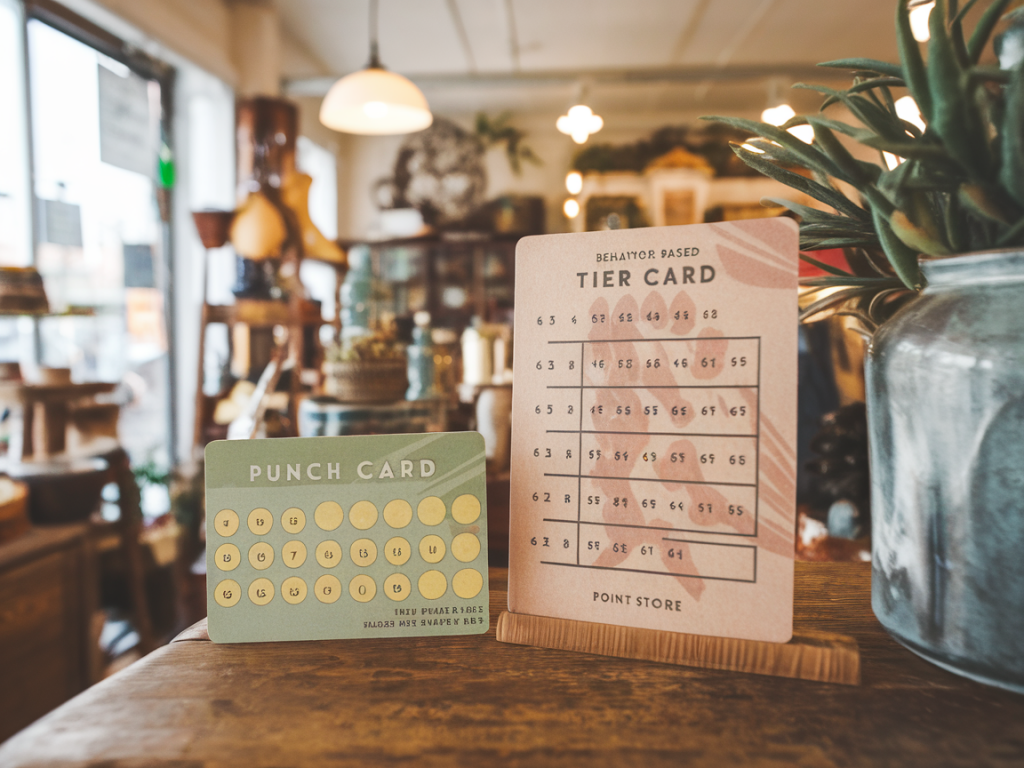
I used to recommend punch-card offers as the first loyalty mechanic for almost every indie retailer I worked with. They’re simple, easy to explain on the shop floor, and cheap to run. But after a few iterations with different brands I learned the hard way that sticking with punch-cards too long limits your ability to grow meaningful customer value. At some point you need to graduate to behaviour-based tiers if you want to nudge frequency, increase basket size and reward your best customers in ways that actually change behaviour.
Why tiers, and why now?
Punch-cards are a great entry point: they drive repeat visits through a clear, tangible objective (“buy 9, get the 10th free”). But they’re blunt instruments. They reward volume without discriminating between high-value and low-value visits, ignore non-transactional behaviours (referrals, reviews, social shares), and don’t give you the nuance to personalise incentives.
Behaviour-based tiers (Bronze–Silver–Gold or similar) let you reward multiple dimensions: purchase frequency, average order value (AOV), product mix (e.g. accessories vs big-ticket items), and engagement behaviours. That makes it easier to create aspirational ladders and personalised perks that increase long-term retention and lifetime value (LTV).
Signals that it’s time to move from punch-cards to tiers
- Your repeat rate is plateauing. If customers return to the same cadence as when the punch-card launched and growth stalls after the initial bump, you’re likely rewarding one-time behaviour instead of changing habits.
- High administrative friction. Staff are losing cards, customers forget them, or you’re spending time reconciling free items. That’s a UX and operational cost.
- Limited data capture. Punch-cards rarely capture identity-linked behavioural data. If most of your returns are anonymous, you can’t personalise offers or measure cohort LTV.
- Large variance in customer value. If some buyers are 3x–5x more valuable but receive the exact same reward as casual buyers, you’re missing out on margin optimisation.
- You want to drive more than visits. If you want to increase AOV, cross-sell, or encourage non-transaction behaviours (referrals, reviews), tiers let you attach specific, meaningful perks to those actions.
- Marketing automation becomes possible. You have an email list, POS data, or an app. When you can identify customers reliably, tiers become feasible and effective.
Practical checklist before you launch tiers
Below is a checklist I use when advising indie retailers. Treat it as a pragmatic sequence: you don’t need everything perfect, but these items reduce risk and speed up impact.
| Checklist item | Why it matters | Minimum acceptable standard |
|---|---|---|
| Customer identification | To map behaviour to tiers, you must reliably identify customers. | Email capture at POS or a loyalty app with account login; 50%+ identified repeat visitors. |
| Basic segmentation | Know who your high, mid and low-value customers are. | RFM (recency, frequency, monetary) buckets in your CRM or spreadsheet. |
| Clear tier rules | Transparent, achievable criteria eliminate confusion. | Two or three tiers with 2–3 measurable criteria (visits/month, spend threshold, referral points). |
| Simple, meaningful perks | Perks must feel valuable without killing margin. | Perks mix of experiential (priority access), economic (5% off), and recognition (exclusive events). |
| Measurement framework | To prove value and iterate. | Baseline KPIs: repeat rate, AOV, 30/90/365-day LTV, churn by cohort. |
| Operational readiness | Staff can explain tiers and apply perks consistently. | Short one-page SOP for staff + 1 training session. |
| Technology fit | Your stack must support tracking and communication. | POS or CRM that can tag customers and trigger emails; integration or CSV export ability. |
Design tips that work for indie retailers
- Keep tiers few and aspirational. Two tiers is often better than three for small stores. Bronze (entry) + Gold (aspirational) reduces confusion and drives clearer goals.
- Mix economic and experiential perks. Small discounts can erode margin. Try member-only events, early access to new products, or free gift wrapping as alternatives.
- Make status visible. Status badges in email, receipts or an app profile make loyalty feel earned. People share badges; social proof attracts others.
- Reward behaviours, not just spend. Give points for referrals, first review, birthday purchase, or bringing reusable bags—these create brand-aligned outcomes.
- Use time-limited tiers or rolling windows. Require qualification over a 12-month rolling period to avoid permanently locking customers into a status they no longer deserve.
- Design an achievable ‘wow’ reward. A reward that customers can realistically reach in a season or two keeps them engaged—e.g., exclusive half-day styling consultation after 6 qualifying purchases.
Minimum tech stack for indie retailers
You don’t need enterprise software to run tiers. Here’s what has worked repeatedly for my clients:
- Email provider that segments (Mailchimp, Klaviyo).
- POS or ecommerce platform that allows customer profiles and tags (Square, Lightspeed, Shopify).
- Simple CRM or spreadsheet with RFM calculations (Google Sheets + a few formulas works fine).
- Optional: lightweight loyalty app (Yotpo, Smile.io, or local partners) if you want in-store check-ins or gamified points.
How to test tiers without full rollout
- Pilot with a customer subset. Invite your most engaged 10–20% to a “founder’s tier” for three months and compare behaviour to a control group.
- A/B test specific perks. Keep tier rules constant but swap a discount for an experience and see which moves revenue or retention more.
- Run time-limited promotions. Create a pop-up tier for a season (e.g., “Summer Club”) to validate mechanics and demand before building permanent infrastructure.
Common pitfalls to avoid
- Overcomplicating qualification. If customers can’t mentally compute “how close am I?” they’ll disengage. Keep thresholds obvious.
- Overpromising perks. Exclusive access that’s irrelevant or rarely used doesn’t build loyalty. Test low-cost experiences first.
- Ignoring staff incentives. If your team doesn’t benefit from membership, they won’t promote it. Create small commission or recognition for sign-ups.
- Neglecting measurement. Launching without baseline KPIs means you won’t know if tiers moved the needle. Set and track cohort LTV, retention and AOV.
Shifting from punch-cards to behaviour-based tiers is a transition from a transactional mindset to a relationship mindset. For indie retailers, the goal isn’t a complex loyalty empire — it’s a simple, measurable system that rewards the behaviours you actually want, integrates with the reality of a small operation, and is flexible enough to evolve as you learn. When you see the signals above and tick the checklist items, tiers become less of a gamble and more of a predictable lever for growth.